EARNED MEDIA
option 1: Thought-leadership piece
Sports Culture Cannot Call Itself Inclusive While Access Remains Unequal
If access to sports and sneaker culture is still shaped by scarcity, geography, and exclusivity, brands can no longer claim inclusion without changing the systems behind it.

Lauren Hobart
President and CEO of DICK’S Sporting Goods
Sports culture likes to describe itself as inclusive. But if access is still determined by scarcity, geography, and exclusivity, inclusion remains more slogan than reality.
For decades, sports have been framed as a universal language—something that transcends background, identity, and circumstance. Yet for many young people today, especially within Gen Z, access to sports and sneaker culture tells a different story. Participation is not as open as we often claim. It is shaped by systems that reward proximity, timing, and privilege more than shared enthusiasm.
This is not simply a market dynamic. It is a social issue.
Across the industry, access to sneaker culture has become increasingly uneven. Limited releases, geographically concentrated experiences, and hype-driven distribution models have created an environment in which visibility is widespread, but meaningful participation is not. Young consumers can follow every drop, every collaboration, and every cultural moment in real time, yet far fewer are positioned to actually take part in them.
That imbalance has consequences. When access is restricted, culture becomes performative rather than participatory. It signals that belonging is conditional—that some people are invited in, while others are expected to watch from the sidelines. For an industry that often speaks in the language of community, this contradiction should not be ignored.
For brands operating at the intersection of sport, culture, and community, this is not an abstract issue. It is a responsibility issue.
At DICK’S Sporting Goods, we believe access must be treated as a principle, not a privilege. Sport has always been strongest when it creates shared experience—when it brings people together rather than separating them. The same standard should apply to the culture that surrounds it.
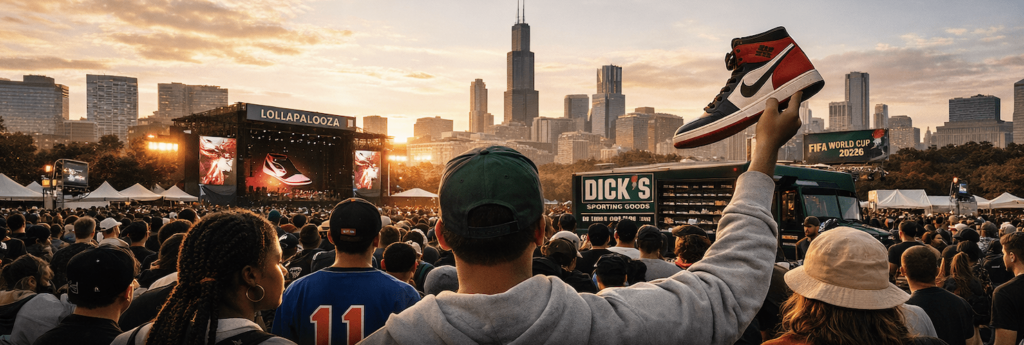
That belief is shaping how we think about innovation. Expanding access requires more than incremental change; it requires rethinking how and where engagement happens. It means moving beyond models that rely too heavily on exclusivity as a measure of value. It means meeting consumers in the spaces where they already gather, whether at major cultural events, within local communities, or in everyday public settings.
The goal should not be to amplify exclusivity. The goal should be to reduce barriers and expand participation.
This is also where responsibility intersects with long-term business value. Gen Z is not only evaluating products. They are evaluating systems. They are paying attention to who is included, who is excluded, and whether brands are willing to address that imbalance in a credible way. In that environment, access is no longer a secondary concern. It is central to trust.
If brands continue to benefit from restricted access without acknowledging its implications, they risk undermining the very communities they claim to support. Inclusion cannot remain a narrative if it is not reflected in practice.
The future of sports culture will not be defined by how effectively we create demand, but by how deliberately we expand participation. Brands will be measured not only by the hype they generate, but by the access they enable.
Access should not be treated as a competitive advantage. It should be treated as a responsibility—and in the years ahead, the brands that understand that distinction will be the ones that remain truly relevant.
Publication: Fast Company
Fast Company is an appropriate outlet for this thought-leadership piece because the article sits at the intersection of business, culture, innovation, and social responsibility. The piece does not function as a promotion for a specific campaign; instead, it presents a broader CEO perspective on unequal access within sports and sneaker culture as a systemic issue. This makes the argument especially suited to a publication that values forward-looking business leadership and cultural commentary. The tone is analytical, values-driven, and strategic, which aligns with Fast Company’s editorial style while also reinforcing DICK’S Sporting Goods’ positioning around access, participation, and community.
Strategy Note
This thought-leadership piece focuses on a single Social ESG issue: unequal access to sports and sneaker culture. That issue aligns closely with DICK’S Sporting Goods’ broader positioning around access, participation, and community, while also allowing the brand to take a clear and credible stance on a systemic challenge affecting Gen Z audiences.
The article is designed to position the CEO as an industry voice addressing a broader cultural issue rather than promoting a specific campaign. By framing access inequality as a matter of inclusion, responsibility, and long-term credibility, the piece expands DICK’S brand narrative beyond retail and into a more values-driven conversation. This makes the message appropriate for a major publication and strengthens its relevance in an earned media context.
The messaging also aligns with the paid campaign without repeating its executional language. In paid media, DICK’S expresses this idea through the sneaker truck activation and the goal of reducing barriers to participation. In earned media, the brand expresses the same core belief as a point of view: that sports culture cannot claim inclusion while access remains unequal. Together, the two channels reinforce a shared strategic idea while serving different communication purposes.
Junrui Peng | USC Annenberg Comp Exam 2026